
Start Your
Divorce Online.
No Lawyers,
No Hidden Fees.
OnlineDivorce helps couples move on — quick, affordable state-specific paperwork based on your situation.
Already have an account?
Only
$199
Have helped
500,000
people with their divorce.
Trusted
20+ years guiding couples through online divorce.
Efficient
Where speed meets affordability – less time, less stress, less money.
Transparent
Flat-rate pricing. No hourly billing. No surprise fees. Nothing you don’t need.
2025
Best Online Divorce Service
Start Your
Divorce Online.
No Lawyers,
No Hidden Fees.
OnlineDivorce helps couples move on — quick, affordable state-specific paperwork based on your situation.
Already have an account?
Only
$199
Have helped
500,000
people with their divorce.
Trusted
20+ years guiding couples through online divorce.
Efficient
Where speed meets affordability – less time, less stress, less money.
Transparent
Flat-rate pricing. No hourly billing. No surprise fees. Nothing you don’t need.
2025
Best Online Divorce Service


Start Your Divorce Online. No Lawyers,
No Hidden Fees.
OnlineDivorce helps couples move on — quick, affordable state-specific paperwork based on your situation.
Already have an account?
20+ years guiding couples through online divorce. Over 250,000 couples served.
Trusted
Efficient
Where speed meets affordability – less time, less stress, less money.
Transparent
Flat-rate pricing. No hourly billing. No surprise fees. Nothing you don’t need.
Start Your Divorce Online. No Lawyers, No Hidden Fees.
OnlineDivorce helps couples move on — quick, affordable state-specific paperwork based on your situation.
Already have an account?
Only
$199
Have helped
500,000
people with their divorce.
Trusted
20+ years guiding couples through online divorce.
Efficient
Where speed meets affordability – less time, less stress, less money.
Transparent
Flat-rate pricing. No hourly billing. No surprise fees. Nothing you don’t need.
2025
Best Online Divorce Service
Online Divorce in Alamosa County

Please note: OnlineDivorce.com in Alamosa County, Colorado, is a divorce document preparation service, not a law firm. Online Divorce is not eligible to provide legal advice. All the information below is for informational purposes only. A dissolution of marriage is challenging because children, property, and hurt emotions are involved. Plus, to decide on child custody and divide assets, a divorcing couple should also be aware of Family Law and local rules in the state where they live. It can become overwhelming and be difficult to do without some help. So OnlineDivorce.com is here to assist you. Use OnlineDivorce.com, and you will see that filing for divorce in Colorado has never been more comfortable or more affordable than it is now. If you and your spouse agree to have no contest over divorce-related matters, you can have an uncontested divorce. An uncontested divorce means that you have no intention to take your divorce case to trial and want to resolve child custody, alimony, and property division amicably. Besides, having an uncontested divorce in Colorado can be a Do-It-Yourself case where you handle it on your own without hiring attorneys. It is the easiest way to get a divorce, as Colorado is a no-fault state, and neither spouse is required to specify their grounds for divorce to start the proceedings. You simply fill out the paperwork and file it with the court. Given that most people do not have legal experience and may feel somewhat intimidated by completing divorce documents, OnlineDivorce.com greatly simplifies the paperwork processes so that divorcing spouses do not need to waste their time studying laws and searching the Internet. Based on your answers to a questionnaire, OnlineDivorce.com will select and complete the necessary forms for your divorce case. Your printable legal forms will be available within two business days. OnlineDivorce.com also gives easy-to-follow filing instructions and a self-help guide to assist you. Using OnlineDivorce.com is the fastest way to initiate a divorce in Colorado. You can get the divorce paperwork completed from the comfort of your home and be confident that everything is done correctly. All that is left to do is file the divorce paperwork with a local courthouse. Everything can be done without a lawyer. Before starting, get familiar with the divorce procedure and how to get a divorce in Colorado.
Online Divorce in Alamosa County
Please note: OnlineDivorce.com in Alamosa County, Colorado, is a divorce document preparation service, not a law firm. Online Divorce is not eligible to provide legal advice. All the information below is for informational purposes only. A dissolution of marriage is challenging because children, property, and hurt emotions are involved. Plus, to decide on child custody and divide assets, a divorcing couple should also be aware of Family Law and local rules in the state where they live. It can become overwhelming and be difficult to do without some help. So OnlineDivorce.com is here to assist you. Use OnlineDivorce.com, and you will see that filing for divorce in Colorado has never been more comfortable or more affordable than it is now. If you and your spouse agree to have no contest over divorce-related matters, you can have an uncontested divorce. An uncontested divorce means that you have no intention to take your divorce case to trial and want to resolve child custody, alimony, and property division amicably. Besides, having an uncontested divorce in Colorado can be a Do-It-Yourself case where you handle it on your own without hiring attorneys. It is the easiest way to get a divorce, as Colorado is a no-fault state, and neither spouse is required to specify their grounds for divorce to start the proceedings. You simply fill out the paperwork and file it with the court. Given that most people do not have legal experience and may feel somewhat intimidated by completing divorce documents, OnlineDivorce.com greatly simplifies the paperwork processes so that divorcing spouses do not need to waste their time studying laws and searching the Internet. Based on your answers to a questionnaire, OnlineDivorce.com will select and complete the necessary forms for your divorce case. Your printable legal forms will be available within two business days. OnlineDivorce.com also gives easy-to-follow filing instructions and a self-help guide to assist you. Using OnlineDivorce.com is the fastest way to initiate a divorce in Colorado. You can get the divorce paperwork completed from the comfort of your home and be confident that everything is done correctly. All that is left to do is file the divorce paperwork with a local courthouse. Everything can be done without a lawyer. Before starting, get familiar with the divorce procedure and how to get a divorce in Colorado.
Valid grounds to get divorced in Alamosa County
Like many other US states, Colorado does not require any fault-based grounds to finalize a divorce. It means that even in cases of adultery or misconduct, it will not affect the court's decision on property division or maintenance. As a purely no-fault state, Colorado only requires the person filing for divorce (referred to as petitioner) to cite the "irretrievable breakdown" of the marriage. Colorado Revised Statutes ¤ 14-10-106 (1)(a)(II) states, "The district court shall enter a decree of dissolution of marriage" when "the court finds that the marriage is irretrievably broken." At a final hearing, the judge will ask the petitioner and the respondent for the reasons for divorce. If the parties say that the marriage is irretrievably broken and there is no chance for reconciliation, the judge signs a decree of divorce.
Valid grounds to get divorced in Alamosa County
Like many other US states, Colorado does not require any fault-based grounds to finalize a divorce. It means that even in cases of adultery or misconduct, it will not affect the court's decision on property division or maintenance. As a purely no-fault state, Colorado only requires the person filing for divorce (referred to as petitioner) to cite the "irretrievable breakdown" of the marriage. Colorado Revised Statutes ¤ 14-10-106 (1)(a)(II) states, "The district court shall enter a decree of dissolution of marriage" when "the court finds that the marriage is irretrievably broken." At a final hearing, the judge will ask the petitioner and the respondent for the reasons for divorce. If the parties say that the marriage is irretrievably broken and there is no chance for reconciliation, the judge signs a decree of divorce.
Divorce in Colorado
Custody of the Child in Alamosa County

In a Colorado divorce with children, priority in custody disputes is always the child's best interests. Colorado Revised Statutes ¤ 14-10-124 (1) states, "it is in the best interest of all parties to encourage frequent and continuing contact between each parent and the minor children of the marriage after the parents have separated or dissolved their marriage." That is why Colorado judges express a preference for parents to share child custody. In Colorado, the legal term for physical custody is 'parenting time' and for legal custody 'decision-making responsibilities.' According to Colo. Rev. Stat. ¤ 14-10-124 (1.5)(a) & (b), the court determines custody based upon the motion of each party or at its discretion. To ensure that the determination of parenting time is in the child's best interests and not a threat to the child's emotional and physical development, the court considers: the desires of the parents and the child (if the child is mature enough); what kind of dynamics exists between the child and each parent, the child and their siblings, and the child and any other significant adult who may significantly affect the child's best interests; how well the child has adjusted to their home, school, and community; how physically and mentally fit all participants are (although the court won't deny or restrict parenting time based on a parent's disability alone); whether each parent is cooperative and will not prevent contact between the child and the other parent; and how involved each parent has previously been in the care of the child. The court will also look into the living arrangements of each parent and whether the family has any history of domestic abuse. In Colorado, parenting time is shared 50/50 or 70/30. In the latter case, the parent who lives with the child the most is referred to as a custodial parent, whereas the other parent is non-custodial. As for legal custody, decision-making responsibilities refer to day-to-day decisions and significant decisions on health care, religion, education, residence, etc. Before the court determines legal custody, it looks into whether a parent is willing to have it and whether a parent is physically and mentally able to have it. Typically, Colorado courts prefer to divide decision-making responsibilities equally between both parents provided that it is in the best interests of the child. When deciding, the court will consider: whether both parents can cooperate and make child-related decisions together; whether the parents have already demonstrated cooperation and mutual support in providing a positive and nourishing relationship; and whether either parent is discouraging the child from staying in close contact with the other parent. Although sole legal custody of the child is rare in Colorado family courts, it can happen in case of a history of domestic violence or child abuse. However, any other types of behaviors that have no relation to the parent's relationship with the child shall not affect the court's determination of custody (see Colo. Rev. Stat. ¤ 14-10-124 (1.5)(b)(2)). After the court issues an order regarding custody, each spouse submits a parental agreement to detail how they plan to split their parenting time and decision-making responsibilities. If the spouses fail to do so or if the court does not approve their parenting plan, the judge drafts a parenting plan for the parents (see Colo. Rev. Stat. ¤ 14-10-124 (7)). If the court discovers that a parent has had a history of domestic violence, child abuse, or neglect, only supervised visitation is possible or no visitation at all. The court always takes a gender-neutral approach in a custody determination. A judge will not automatically assume that the child is better off with the mother. Though mothers do get involved in the child's care more often than fathers, ultimately, it is up to the parents to express their desires to share child custody equally and pursue it with a detailed parenting plan and involvement in the child's care.
Divorce in Colorado
Custody of the Child in Alamosa County
In a Colorado divorce with children, priority in custody disputes is always the child's best interests. Colorado Revised Statutes ¤ 14-10-124 (1) states, "it is in the best interest of all parties to encourage frequent and continuing contact between each parent and the minor children of the marriage after the parents have separated or dissolved their marriage." That is why Colorado judges express a preference for parents to share child custody. In Colorado, the legal term for physical custody is 'parenting time' and for legal custody 'decision-making responsibilities.' According to Colo. Rev. Stat. ¤ 14-10-124 (1.5)(a) & (b), the court determines custody based upon the motion of each party or at its discretion. To ensure that the determination of parenting time is in the child's best interests and not a threat to the child's emotional and physical development, the court considers: the desires of the parents and the child (if the child is mature enough); what kind of dynamics exists between the child and each parent, the child and their siblings, and the child and any other significant adult who may significantly affect the child's best interests; how well the child has adjusted to their home, school, and community; how physically and mentally fit all participants are (although the court won't deny or restrict parenting time based on a parent's disability alone); whether each parent is cooperative and will not prevent contact between the child and the other parent; and how involved each parent has previously been in the care of the child. The court will also look into the living arrangements of each parent and whether the family has any history of domestic abuse. In Colorado, parenting time is shared 50/50 or 70/30. In the latter case, the parent who lives with the child the most is referred to as a custodial parent, whereas the other parent is non-custodial. As for legal custody, decision-making responsibilities refer to day-to-day decisions and significant decisions on health care, religion, education, residence, etc. Before the court determines legal custody, it looks into whether a parent is willing to have it and whether a parent is physically and mentally able to have it. Typically, Colorado courts prefer to divide decision-making responsibilities equally between both parents provided that it is in the best interests of the child. When deciding, the court will consider: whether both parents can cooperate and make child-related decisions together; whether the parents have already demonstrated cooperation and mutual support in providing a positive and nourishing relationship; and whether either parent is discouraging the child from staying in close contact with the other parent. Although sole legal custody of the child is rare in Colorado family courts, it can happen in case of a history of domestic violence or child abuse. However, any other types of behaviors that have no relation to the parent's relationship with the child shall not affect the court's determination of custody (see Colo. Rev. Stat. ¤ 14-10-124 (1.5)(b)(2)). After the court issues an order regarding custody, each spouse submits a parental agreement to detail how they plan to split their parenting time and decision-making responsibilities. If the spouses fail to do so or if the court does not approve their parenting plan, the judge drafts a parenting plan for the parents (see Colo. Rev. Stat. ¤ 14-10-124 (7)). If the court discovers that a parent has had a history of domestic violence, child abuse, or neglect, only supervised visitation is possible or no visitation at all. The court always takes a gender-neutral approach in a custody determination. A judge will not automatically assume that the child is better off with the mother. Though mothers do get involved in the child's care more often than fathers, ultimately, it is up to the parents to express their desires to share child custody equally and pursue it with a detailed parenting plan and involvement in the child's care.
Divorce in Colorado
Rules for Child Support in Alamosa County
When determining a monthly amount in child support, the court ensures that a dissolution of marriage will have the least impact on the child in terms of financial aid. According to Colo. Rev. Stat. ¤ 14-10-115. Child support guidelines, the court shall "calculate child support based upon the parents' combined adjusted gross income estimated to have been allocated to the child if the parents and children were living in an intact household." When filing for divorce with children in Colorado, divorcing spouses also complete a Child Support Worksheet where they specify their income and other financial aspects of their lives. The disclosure of financial information allows the court to make an informed decision as to child support. Using the Income Shares Model, Colorado courts calculate child support by considering the financial resources and needs of both the child and each parent and the standard of living the family has had. Typically, it is the non-custodial parent who shall pay child support, but it is calculated proportionate to his or her financial resources. However, depending on the parents' arrangement, child support can be paid by both parents. In Colorado, child support continues until the child turns 19, graduates from high school, or enrolls in the army. If the child drops out of high school and then re-enrolls, child support continues until the child graduates or reaches 21 years of age. In the case of disability, the court may order child support beyond the age of 19.
Divorce in Colorado
Rules for Child Support in Alamosa County
When determining a monthly amount in child support, the court ensures that a dissolution of marriage will have the least impact on the child in terms of financial aid. According to Colo. Rev. Stat. ¤ 14-10-115. Child support guidelines, the court shall "calculate child support based upon the parents' combined adjusted gross income estimated to have been allocated to the child if the parents and children were living in an intact household." When filing for divorce with children in Colorado, divorcing spouses also complete a Child Support Worksheet where they specify their income and other financial aspects of their lives. The disclosure of financial information allows the court to make an informed decision as to child support. Using the Income Shares Model, Colorado courts calculate child support by considering the financial resources and needs of both the child and each parent and the standard of living the family has had. Typically, it is the non-custodial parent who shall pay child support, but it is calculated proportionate to his or her financial resources. However, depending on the parents' arrangement, child support can be paid by both parents. In Colorado, child support continues until the child turns 19, graduates from high school, or enrolls in the army. If the child drops out of high school and then re-enrolls, child support continues until the child graduates or reaches 21 years of age. In the case of disability, the court may order child support beyond the age of 19.
Divorce in Colorado
Rules for Spousal Support in Alamosa County

Colorado Family Law does not provide an automatic right to alimony or spousal maintenance. However, if the requesting spouse specifies a lack of employment to support themselves, an intensive schedule of childcare, or any other reason for spousal maintenance, the court may award it. CO REV ST ¤ 14-10-114. Spousal maintenance provides guidelines for the percentage of support awarded to spouses based on the duration of the marriage. Deciding the fact and the amount of the payments for spousal maintenance, the court takes into consideration the length of the marriage, state of health, employment and financial capacity, involvement in the family life, contribution to the spouse's training and the possibility to work, and any other relevant factors. Any changes in either spouse's income, health, or marital status can result in changes to the amount of alimony or the termination of maintenance altogether. Calculate approximate spousal maintenance in Colorado here.
Divorce in Colorado
Rules for Spousal Support in Alamosa County
Colorado Family Law does not provide an automatic right to alimony or spousal maintenance. However, if the requesting spouse specifies a lack of employment to support themselves, an intensive schedule of childcare, or any other reason for spousal maintenance, the court may award it. CO REV ST ¤ 14-10-114. Spousal maintenance provides guidelines for the percentage of support awarded to spouses based on the duration of the marriage. Deciding the fact and the amount of the payments for spousal maintenance, the court takes into consideration the length of the marriage, state of health, employment and financial capacity, involvement in the family life, contribution to the spouse's training and the possibility to work, and any other relevant factors. Any changes in either spouse's income, health, or marital status can result in changes to the amount of alimony or the termination of maintenance altogether. Calculate approximate spousal maintenance in Colorado here.
Divorce in Colorado
Property Division in Alamosa County

According to CO REV ST ¤ 14-10-113. Disposition of Property, the court considers how much each spouse contributed to the acquisition of marital property. It can include the contribution of a spouse as homemaker, how much each spouse's separate property value, what income and employment each spouse have, and whether the value of each spouse's separate property has changed during the marriage. Belonging to the equitable distribution states, Colorado distinguishes between separate property and marital property. Colorado courts typically accept a fair and equal distribution of marital assets memorialized in a marital settlement agreement. However, if the spouses are unable to agree on property division, the court uses the dual classification model to categorize separate and marital property then distributes the property between the spouses.
Divorce in Colorado
Property Division in Alamosa County
According to CO REV ST ¤ 14-10-113. Disposition of Property, the court considers how much each spouse contributed to the acquisition of marital property. It can include the contribution of a spouse as homemaker, how much each spouse's separate property value, what income and employment each spouse have, and whether the value of each spouse's separate property has changed during the marriage. Belonging to the equitable distribution states, Colorado distinguishes between separate property and marital property. Colorado courts typically accept a fair and equal distribution of marital assets memorialized in a marital settlement agreement. However, if the spouses are unable to agree on property division, the court uses the dual classification model to categorize separate and marital property then distributes the property between the spouses.
Divorce in Colorado
Mediation Support in Alamosa County

Mediation can be of great help in a divorce done by yourself, even if the spouses cannot achieve consensus on one or more issues. In a DIY divorce, you and your spouse may stumble on some obstacles, but a skillful mediator is there to help you out without compromising your interests. Mediation can be used at any stage of divorce proceedings by choice of the couple or by order of the court to guide the spouses in resolving their contested issues more efficiently. Mediators are skilled specialists who assist spouses in verbalizing their concerns while keeping unnecessary emotions and complications out of the picture. Although mediators usually charge for their services, unless the court-mandated mediation within legal aid programs, the price you pay will significantly reduce the overall cost of divorce because you will avoid going to a lengthy and expensive trial.
Divorce in Colorado
Mediation Support in Alamosa County
Mediation can be of great help in a divorce done by yourself, even if the spouses cannot achieve consensus on one or more issues. In a DIY divorce, you and your spouse may stumble on some obstacles, but a skillful mediator is there to help you out without compromising your interests. Mediation can be used at any stage of divorce proceedings by choice of the couple or by order of the court to guide the spouses in resolving their contested issues more efficiently. Mediators are skilled specialists who assist spouses in verbalizing their concerns while keeping unnecessary emotions and complications out of the picture. Although mediators usually charge for their services, unless the court-mandated mediation within legal aid programs, the price you pay will significantly reduce the overall cost of divorce because you will avoid going to a lengthy and expensive trial.
Divorce in Colorado
Filing Fees for Divorce in Alamosa County
Colorado courts charge $230 for filing a Petition for Dissolution of Marriage (Divorce) and $116 for filing a Response. To waive the payment, you must fill out a Motion to File In Forma Pauperis (MIFP).
Divorce in Colorado
Filing Fees for Divorce in Alamosa County
Colorado courts charge $230 for filing a Petition for Dissolution of Marriage (Divorce) and $116 for filing a Response. To waive the payment, you must fill out a Motion to File In Forma Pauperis (MIFP).
Divorce in Colorado
How long will it take?
The court cannot finalize your divorce earlier than 90 days after filing the divorce paperwork. The timeline requires that the petitioner files the paperwork, serves the spouse, waits for the spouse's response (21 days), or the spouse's discovery (90 days), and attends a hearing. Getting a divorce legally finalized will depend on many factors, from the caseload of the court to the spouses being cooperative. If you filed for an uncontested divorce but cannot agree with your spouse on some issues, the judge will not sign a decree of dissolution until you resolve custody, support, and property division. On average, a Colorado divorce takes 6-9 months if children and property are involved.
Divorce in Colorado
How long will it take?
The court cannot finalize your divorce earlier than 90 days after filing the divorce paperwork. The timeline requires that the petitioner files the paperwork, serves the spouse, waits for the spouse's response (21 days), or the spouse's discovery (90 days), and attends a hearing. Getting a divorce legally finalized will depend on many factors, from the caseload of the court to the spouses being cooperative. If you filed for an uncontested divorce but cannot agree with your spouse on some issues, the judge will not sign a decree of dissolution until you resolve custody, support, and property division. On average, a Colorado divorce takes 6-9 months if children and property are involved.
Divorce in Colorado
Frequently Asked Questions
How much does a divorce cost in Alamosa County?
The surefire way to reduce the cost of divorce is to have a DIY divorce. It means you compete and file the paperwork on your own. If you have an uncontested divorce, you pay only filing fees and notary fees. In Alamosa County, CO, the filing fee for a civil action is $230. However, you can eliminate the filing fees if you submit a Motion In Forma Pauperis form and get a judge's approval.In more complicated cases, you can still have a cheap divorce if you manage to find a pro bono program and seek consultation from a law clinic.As for attorney fees, lawyers charge an hourly fee. If you and your spouse have no agreement on some issues, it is difficult to predict how many hours of attorney consultations you will need and how much you will pay. On the whole, mediation is cheaper, but if you have complicated financial issues, it can be best to hire experts to protect your interests in the long run.
How to file for divorce in Alamosa County without a lawyer?
OnlineDivorce.com provides easy to follow instructions for a Do-It-Yourself divorce in Colorado. It has all the information you need to start a divorce without legal representation. Besides, each local courthouse has a self-help center and resources for pro se litigants.
What are the required forms for an uncontested divorce in Alamosa County?
Here is a list of court forms generally required for divorces with children in Colorado. Petition for Dissolution of Marriage Case Information Sheet Summons for Dissolution of Marriage Waiver and Acceptance of Service/Return of Service Petitioner's Verified Motion and Order for Publication Response Notice of Domestic Relations Initial Status Conference Notice of Domestic Relations Status Conference Temporary Orders Agreement and Temporary Orders Form Mandatory Disclosure, Form 35.1 Sworn Financial Statement, Form 35.2 Certificate of Compliance with Mandatory Financial Disclosures Decree of Dissolution Affidavit for Decree without the Appearance of Parties Separation Agreement Qualified Domestic Relations Order Notice to Set Hearing Notice of Hearing Worksheet A -- Child Support Obligation: Sole Physical Care Worksheet B -- Child Support Obligation: Shared Physical Care Support Order Parenting Plan Notice to Withhold Income for Support Notice to Employer to Deduct for Health Insurance Notice of Insurance Provider of Court-ordered Health Insurance Coverage
Can I file for legal separation in Alamosa County, Colorado?
Yes. The procedure for legal separation is similar to that for the dissolution of marriage. The only difference is that the spouses cannot remarry as they are not divorced yet.
When is it allowed to remarry after a divorce?
In Colorado, divorced people can remarry as soon as the divorce decree is processed. They do not need to wait any longer.
Divorce in Colorado
Frequently Asked Questions
How much does a divorce cost in Alamosa County?
The surefire way to reduce the cost of divorce is to have a DIY divorce. It means you compete and file the paperwork on your own. If you have an uncontested divorce, you pay only filing fees and notary fees. In Alamosa County, CO, the filing fee for a civil action is $230. However, you can eliminate the filing fees if you submit a Motion In Forma Pauperis form and get a judge's approval.In more complicated cases, you can still have a cheap divorce if you manage to find a pro bono program and seek consultation from a law clinic.As for attorney fees, lawyers charge an hourly fee. If you and your spouse have no agreement on some issues, it is difficult to predict how many hours of attorney consultations you will need and how much you will pay. On the whole, mediation is cheaper, but if you have complicated financial issues, it can be best to hire experts to protect your interests in the long run.
How to file for divorce in Alamosa County without a lawyer?
OnlineDivorce.com provides easy to follow instructions for a Do-It-Yourself divorce in Colorado. It has all the information you need to start a divorce without legal representation. Besides, each local courthouse has a self-help center and resources for pro se litigants.
What are the required forms for an uncontested divorce in Alamosa County?
Here is a list of court forms generally required for divorces with children in Colorado. Petition for Dissolution of Marriage Case Information Sheet Summons for Dissolution of Marriage Waiver and Acceptance of Service/Return of Service Petitioner's Verified Motion and Order for Publication Response Notice of Domestic Relations Initial Status Conference Notice of Domestic Relations Status Conference Temporary Orders Agreement and Temporary Orders Form Mandatory Disclosure, Form 35.1 Sworn Financial Statement, Form 35.2 Certificate of Compliance with Mandatory Financial Disclosures Decree of Dissolution Affidavit for Decree without the Appearance of Parties Separation Agreement Qualified Domestic Relations Order Notice to Set Hearing Notice of Hearing Worksheet A -- Child Support Obligation: Sole Physical Care Worksheet B -- Child Support Obligation: Shared Physical Care Support Order Parenting Plan Notice to Withhold Income for Support Notice to Employer to Deduct for Health Insurance Notice of Insurance Provider of Court-ordered Health Insurance Coverage
Can I file for legal separation in Alamosa County, Colorado?
Yes. The procedure for legal separation is similar to that for the dissolution of marriage. The only difference is that the spouses cannot remarry as they are not divorced yet.
When is it allowed to remarry after a divorce?
In Colorado, divorced people can remarry as soon as the divorce decree is processed. They do not need to wait any longer.
Divorce in Colorado
Here is how OnlineDivorce.com makes completing divorce papers easier:
We provide the full divorce packet required by the local court - clients do not need to drive to their local courthouse to get the blank forms or search for the right divorce forms online. In rare cases, local county forms can vary in color, paper material, size, or bar code, so they may need to be obtained directly from the county clerk's office.
We complete the necessary forms for clients based on their answers given in a simple guided online interview - clients do not need to understand family law or read through complicated instructions to figure out how to fill out the forms themselves.
We give detailed, easy to follow step-by-step instructions for filing a divorce with the court - so the client knows exactly what to do to get his/her divorce finalized.
We provide unlimited technical support - if a client needs assistance through the online process, he/she can always reach out to us via phone, email, or live chat, and we'll do our best to help.
We save our clients time and money - if divorcing spouses agree regarding the terms of their divorce, they typically don’t have to pay thousands to a lawyer to handle their divorce forms and don't need to spend hours trying to do it all by themselves.
Divorce in Colorado
Here is how OnlineDivorce.com makes completing divorce papers easier:
We provide the full divorce packet required by the local court - clients do not need to drive to their local courthouse to get the blank forms or search for the right divorce forms online. In rare cases, local county forms can vary in color, paper material, size, or bar code, so they may need to be obtained directly from the county clerk's office.
We complete the necessary forms for clients based on their answers given in a simple guided online interview - clients do not need to understand family law or read through complicated instructions to figure out how to fill out the forms themselves.
We give detailed, easy to follow step-by-step instructions for filing a divorce with the court - so the client knows exactly what to do to get his/her divorce finalized.
We provide unlimited technical support - if a client needs assistance through the online process, he/she can always reach out to us via phone, email, or live chat, and we'll do our best to help.
We save our clients time and money - if divorcing spouses agree regarding the terms of their divorce, they typically don’t have to pay thousands to a lawyer to handle their divorce forms and don't need to spend hours trying to do it all by themselves.
Divorce in Colorado
Divorce Courts in Alamosa County
Alamosa County Courthouse
Clerk Name:
Suzanne Fredrickson
Court Address:
702 4th
Alamosa,
CO
81101
Phone:
719-589-4996
Clerk Hours:
8am-4pm
Divorce in Colorado
Divorce Courts in Alamosa County
Alamosa County Courthouse
Clerk Name:
Suzanne Fredrickson
Court Address:
702 4th
Alamosa,
CO
81101
Phone:
719-589-4996
Clerk Hours:
8am-4pm
Our simple
4-step process
We guide you through each step, from paperwork to final filing, so you can move forward with confidence—saving time, stress, and money.
Step 1
See if you qualify
Find out if you and your circumstances are eligible for our easy divorce process.
Step 2
Complete the questionnaire
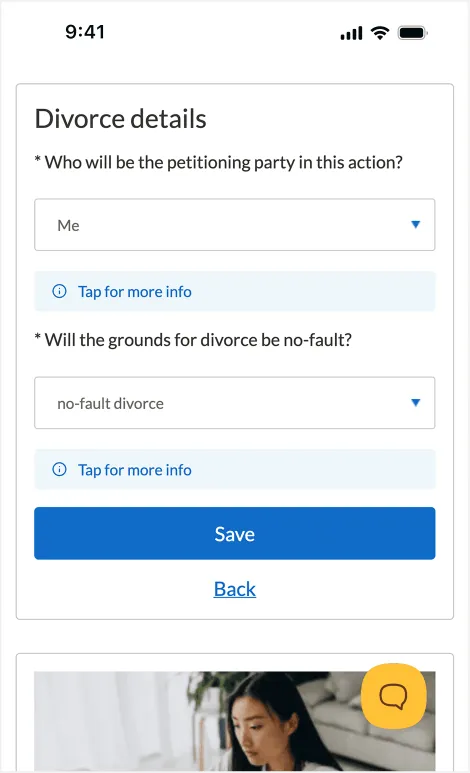
Our questionnaire guides you through filling out divorce paperwork.
Step 3
Review your forms
Review your personalized legal documents before final submission.
Step 4
File for divorce
Take the final step towards your new beginning with detailed filing instructions.
Our simple
4-step process
We guide you through each step, from paperwork to final filing, so you can move forward with confidence—saving time, stress, and money.
Step 1
See if you qualify
Find out if you and your circumstances are eligible for our easy divorce process.

Step 2
Complete the questionnaire
Our questionnaire guides you through filling out divorce paperwork.
Step 3
Review your forms
Review your personalized legal documents before final submission.

Step 4
File for divorce
Take the final step towards your new beginning with detailed filing instructions.

Our simple
4-step process
We guide you through each step, from paperwork to final filing, so you can move forward with confidence—saving time, stress, and money.
Step 1
See if you qualify
Find out if you and your circumstances are eligible for our easy divorce process.
Step 2
Complete the questionnaire
Our questionnaire guides you through filling out divorce paperwork.
Step 3
Review your forms
Review your personalized legal documents before final submission.
Step 4
File for divorce
Take the final step towards your new beginning with detailed filing instructions.
Our simple
4-step process
We guide you through each step, from paperwork to final filing, so you can move forward with confidence—saving time, stress, and money.
Step 1
See if you qualify
Find out if you and your circumstances are eligible for our easy divorce process.
Step 2
Complete the questionnaire
Our questionnaire guides you through filling out divorce paperwork.
Step 3
Review your forms
Review your personalized legal documents before final submission.
Step 4
File for divorce
Take the final step towards your new beginning with detailed filing instructions.
Over 500,000 people
have used OnlineDivorce
For over 24 years, we’ve empowered individuals to get quick and stress-free divorces while saving money in the process.




Over 500,000 people have used OnlineDivorce
For over 24 years, we’ve empowered individuals to get quick and stress-free divorces while saving money in the process.
Over 500,000 people
have used OnlineDivorce
For over 24 years, we’ve empowered individuals to get quick and stress-free divorces while saving money in the process.
Over 500,000 people have used OnlineDivorce
For over 24 years, we’ve empowered individuals to get quick and stress-free divorces while saving money in the process.
It's less
expensive
Contested divorces can cost on average $11,000 in lawyer fees. OnlineDivorce is fast, affordable, and simple.
$199
Limited time offer
An easy and quick method to prepare for uncontested divorce online and get high-quality divorce papers
A complete packet of divorce documents at a low cost
Fast preparation of all court forms within 2 business days
Thorough instructions explaining how to start a divorce
Convenient to use from any device at any time
Responsive customer email, chat, and phone support
Traditional Divorce
>$11,000
on average
Divorce with a lawyer can be adversarial, lengthy, inconvenient and costly
Litigated divorces are expensive - $11,000 on average
They take longer to get finalized - up to a few years
Little or no control over the divorce outcome
Litigation ignites more conflicts between the parties
Prolonged court trials negatively affect children
It's less
expensive
Contested divorces can cost on average $11,000 in lawyer fees. OnlineDivorce is fast, affordable, and simple.
$199
Limited time offer
An easy and quick method to prepare for uncontested divorce online and get high-quality divorce papers
A complete packet of divorce documents at a low cost
Fast preparation of all court forms within 2 business days
Thorough instructions explaining how to start a divorce
Convenient to use from any device at any time
Responsive customer email, chat, and phone support
Traditional Divorce
>$11,000
on average
Divorce with a lawyer can be adversarial, lengthy, inconvenient and costly
Litigated divorces are expensive - $11,000 on average
They take longer to get finalized - up to a few years
Little or no control over the divorce outcome
Litigation ignites more conflicts between the parties
Prolonged court trials negatively affect children
It's less
expensive
Contested divorces can cost on average $11,000 in lawyer fees. OnlineDivorce is fast, affordable, and simple.
$199
Limited time offer
An easy and quick method to prepare for uncontested divorce online and get high-quality divorce papers
A complete packet of divorce documents at a low cost
Fast preparation of all court forms within 2 business days
Thorough instructions explaining how to start a divorce
Convenient to use from any device at any time
Responsive customer email, chat, and phone support
Traditional Divorce
>$11,000
on average
Divorce with a lawyer can be adversarial, lengthy, inconvenient and costly
Litigated divorces are expensive - $11,000 on average
They take longer to get finalized - up to a few years
Little or no control over the divorce outcome
Litigation ignites more conflicts between the parties
Prolonged court trials negatively affect children
It's less
expensive
Contested divorces can cost on average $11,000 in lawyer fees. OnlineDivorce is fast, affordable, and simple.
$199
Limited time offer
An easy and quick method to prepare for uncontested divorce online and get high-quality divorce papers
A complete packet of divorce documents at a low cost
Fast preparation of all court forms within 2 business days
Thorough instructions explaining how to start a divorce
Convenient to use from any device at any time
Responsive customer email, chat, and phone support
Traditional Divorce
>$11,000
on average
Divorce with a lawyer can be adversarial, lengthy, inconvenient and costly
Litigated divorces are expensive - $11,000 on average
They take longer to get finalized - up to a few years
Little or no control over the divorce outcome
Litigation ignites more conflicts between the parties
Prolonged court trials negatively affect children
Support for
all types of divorces
Every divorce is different, but with OnlineDivorce you
can personalize your assistance for every aspect of your online divorce.
Support for
all types of divorces
Every divorce is different, but with OnlineDivorce you can personalize your assistance for every aspect of your online divorce.
Support for
all types of divorces
Every divorce is different, but with OnlineDivorce you
can personalize your assistance for every aspect of your online divorce.
Support for
all types of divorces
Every divorce is different, but with OnlineDivorce you
can personalize your assistance for every aspect of your online divorce.
Complete your divorce from start to finish
From filing to finalization, we guide you every step of the way—quick, affordable, and stress-free.
Complete your divorce from start to finish
From filing to finalization, we guide you every step of the way—quick, affordable, and stress-free.
Complete your divorce from start to finish
From filing to finalization, we guide you every step of the way—quick, affordable, and stress-free.